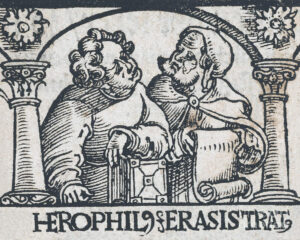
Herophilus (c. 335–280 BC) was a pioneering Greek physician and anatomist who lived and worked in Alexandria. He is often called the **father of anatomy** for being the first to perform systematic scientific dissections of human cadavers, a practice that was revolutionary at the time. Herophilus made groundbreaking discoveries about the brain, identifying it as the center of the nervous system, and distinguished nerves from blood vessels and tendons. He also described various organs in detail, including parts of the digestive and reproductive systems, and contributed to early neuroanatomy by classifying nerves as sensory or motor.Erasistratus (c. 304–c. 250 BC), a younger contemporary of Herophilus, was also a Greek anatomist and royal physician who worked in Alexandria. Alongside Herophilus, he conducted human dissections and made significant advances in understanding the heart as a pump and the brain’s role in motor control through nerves. Erasistratus emphasised mechanical and physiological explanations over traditional humoral theories and promoted preventive medicine and hygiene. Together, they laid the foundations of anatomy and physiology, marking a major leap in medical science that was not matched until the Renaissance.