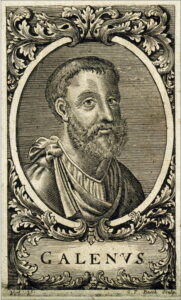
Galen of Pergamon (c. 129–c. 210 AD) was a Greek physician, surgeon, and philosopher whose work dominated medical theory and practice in Europe for nearly 1,400 years. He combined extensive anatomical observation—mainly from dissections of animals—with philosophical ideas from Plato and Aristotle to develop a comprehensive system of medicine. Galen advanced the understanding of anatomy, physiology, pathology, and pharmacology, and was the first to use the pulse as a diagnostic tool. He also refined the Hippocratic humoral theory by localizing imbalances to specific organs, allowing more precise diagnoses and treatments.
Galen revolutionized medicine by integrating empirical observation with philosophical reasoning, emphasizing experimentation alongside established medical teachings. He described the nervous system’s control over muscles, detailed surgical techniques, and proposed a complex model of bodily functions involving the brain, heart, and liver distributing different “spirits” through the body. His anatomical and physiological theories, although partly based on animal dissection, remained authoritative until the Renaissance challenged and corrected many of his ideas. Galen’s ethical approach and interdisciplinary method laid the foundation for systematic medicine and medical education for centuries.